
Applying for immigration relief under the Violence Against Women Act (VAWA) can feel overwhelming, especially for survivors who are already dealing with the emotional effects of abuse. The process may involve preparing forms, gathering supporting evidence, explaining your experiences, and responding to requests from U.S. Citizenship and Immigration Services (USCIS).
VAWA allows certain abused spouses, children, and parents of U.S. citizens or lawful permanent residents to self-petition for immigration benefits without relying on the abusive family member. A qualifying self-petitioner may file Form I-360 independently rather than remain dependent on the abuser for immigration sponsorship.
This guide explains the VAWA immigration process in simple steps and highlights where psychological documentation may support a petition. For case-specific legal advice, applicants should consult a qualified immigration attorney.
What is VAWA Immigration?
Determine Your Eligibility
The first step is determining whether you may qualify to file a VAWA self-petition.
Depending on the case, USCIS may consider whether you:
- Have a qualifying relationship with a U.S. citizen or lawful permanent resident
- Experienced battery or extreme cruelty
- Meet applicable residence requirements
- Can establish good moral character
- Meet the other eligibility requirements that apply to your circumstances
Because VAWA eligibility can be complex, applicants should consider discussing their situation with an experienced immigration attorney before filing.
Gather Supporting Evidence
Supporting evidence helps USCIS understand the facts of the case. The exact documents available will vary from one applicant to another.
Possible evidence may include:
- Birth or marriage certificates
- Documents showing the qualifying relationship
- Evidence of shared residence
- Police or court records, when available
- Medical or mental health records
- Emails, text messages, letters, or other communications
- Statements from relatives, friends, or other people familiar with the situation
- The applicant’s personal statement
Not every survivor will have police reports, medical records, or other formal documentation. The strength of a VAWA case should be assessed based on the available evidence and the applicant’s individual circumstances.
Prepare Your Personal Statement
A personal statement gives applicants an opportunity to explain their experiences in their own words.
It may address:
- The relationship with the abusive person
- The nature and pattern of the abuse
- Important events or experiences
- The emotional or psychological effects of the abuse
- How the experience affected daily life, relationships, work, or functioning
- Relevant circumstances surrounding the immigration petition
The statement should be truthful, detailed, and consistent with the applicant’s actual experiences.
Consider a VAWA Psychological Evaluation
A psychological evaluation is not automatically required in every VAWA case, but it may provide useful clinical documentation when emotional or psychological harm is relevant to the petition.
During a VAWA psychological evaluation, a licensed mental health professional may discuss the applicant’s background, experiences of abuse, current symptoms, emotional functioning, and the longer-term psychological effects of those experiences.
The resulting report can document issues such as trauma-related symptoms, depression, anxiety, changes in functioning, or other clinically relevant effects when supported by the evaluation.
USCIS decisions show that psychological evaluations may form part of the overall evidence considered in VAWA matters. In one published AAO decision, for example, USCIS discussed a psychological evaluation describing PTSD, depression, and anxiety related to abuse.
A psychological evaluation should support the clinical aspects of the case; it does not replace legal advice or determine whether a VAWA petition will be approved.
Prepare and File the VAWA Self-Petition
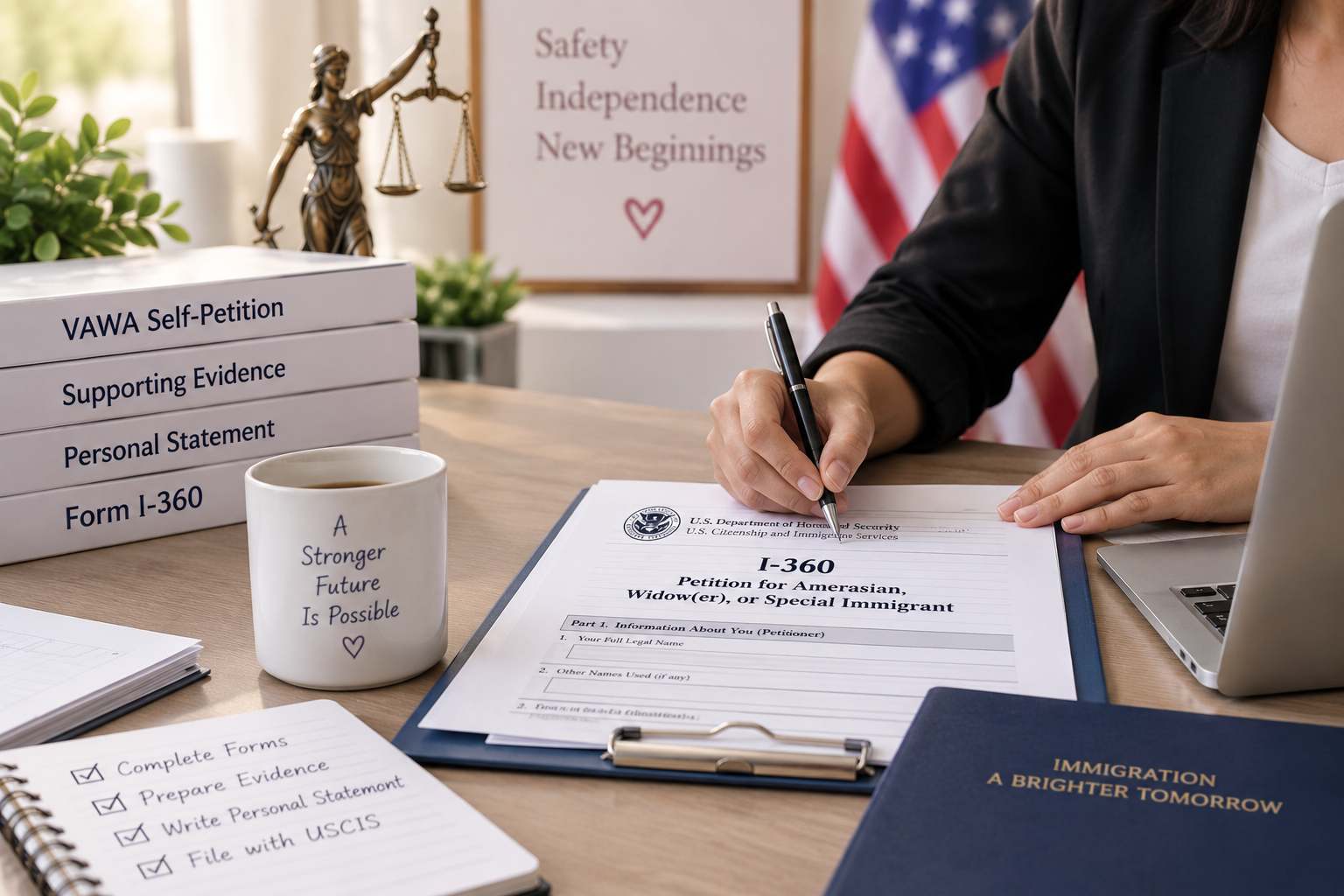
VAWA self-petitions are generally filed using Form I-360.
Before filing, applicants or their legal representatives should carefully review the petition to make sure that:
- Required forms are completed
- Supporting evidence is organized
- Personal statements are signed where required
- Relevant documents are included
- Copies are retained for personal records
Because filing requirements depend on the applicant’s situation, it is important to follow current USCIS instructions and obtain legal guidance when needed.
Respond to USCIS Requests
After reviewing a petition, USCIS may request additional information or documentation.
One possible notice is a Request for Evidence (RFE). An RFE does not automatically mean the petition will be denied. It means USCIS needs additional evidence before it can continue adjudicating the case.
Applicants should carefully review any USCIS notice and respond by the stated deadline. If an attorney is representing the applicant, the attorney can provide guidance on how to prepare the response.
Wait for USCIS to Review the Case
VAWA processing times can vary, so applicants should avoid relying on a fixed timeline unless they are checking current USCIS processing information.
While a petition is pending, it is helpful to:
- Keep copies of all forms and evidence
- Save USCIS receipt notices and correspondence
- Respond promptly to USCIS notices
- Follow the appropriate procedure if the mailing address changes
- Stay in contact with legal counsel, if represented
USCIS has special address-change procedures for VAWA, T, and U-related cases because of the sensitive nature of these filings.
Receive a USCIS Decision
After USCIS completes its review, the applicant will receive a written decision.
An approved VAWA self-petition may make the applicant eligible for additional immigration benefits depending on the person’s circumstances and immigration history. Some applicants may later become eligible to apply for lawful permanent residence, but eligibility should be assessed individually.
Common Mistakes to Avoid
Simple filing and documentation mistakes can create unnecessary complications. Common problems may include:
- Submitting incomplete forms
- Providing inconsistent information
- Missing USCIS deadlines
- Failing to keep copies of submitted documents
- Using unsupported or exaggerated statements
- Sending documents without clearly explaining their relevance
- Assuming every VAWA case requires the same type of evidence
A well-organized petition makes it easier for both the applicant and legal representative to track what has been submitted.
Why Professional Guidance Matters
VAWA cases often involve both complex immigration requirements and difficult personal experiences.
An immigration attorney can advise applicants about legal eligibility, forms, deadlines, and filing strategy. A licensed mental health professional can separately provide clinical assessment and documentation when the psychological impact of abuse is relevant.
Keeping these roles clear is important. Psychological evaluators provide clinical evidence; they do not replace immigration attorneys or make legal determinations.
How a VAWA Psychological Evaluation May Support Your Case
A professionally prepared VAWA psychological evaluation can provide structured clinical documentation of the emotional and psychological effects of abuse.
Depending on the evaluation findings, a report may address:
- Trauma-related symptoms
- Anxiety or depression
- Emotional distress
- Sleep or concentration difficulties
- Changes in daily functioning
- Relationship and social effects
- The connection between reported abuse and psychological symptoms
The purpose is to present clinically supported information in a clear report that can be reviewed alongside the other evidence in the petition.
If you need psychological documentation for a VAWA matter, learn more about our VAWA Psychological Evaluation service.
Conclusion
The VAWA immigration process involves much more than completing a form. Applicants may need to establish eligibility, organize evidence, prepare a personal statement, respond to USCIS notices, and document the effects of abuse through supporting evidence such as immigration evaluations.
Understanding the process can make each stage easier to manage. Legal questions should be handled with a qualified immigration professional, while psychological and other relevant immigration evaluations can provide additional clinical documentation when appropriate.
Frequently Asked Questions About the VAWA Immigration Process
What is the VAWA immigration process?
VAWA allows certain abuse survivors to self-petition for immigration benefits without relying on the abusive family member.
Is a psychological evaluation required for a VAWA petition?
No. It is not required in every case, but it can provide useful clinical documentation of the emotional effects of abuse.
What documents can support a VAWA petition?
Evidence may include personal statements, relationship documents, medical records, police reports, messages, and statements from family or friends.
What happens if USCIS sends an RFE?
An RFE means USCIS needs additional information or evidence before making a decision on the petition.
How long does the VAWA process take?
Processing times vary depending on USCIS workload and the circumstances of the case.
Pingback: Immigration Psychological Evaluation: The Complete 2026 Guide - Insight Health Evaluations